
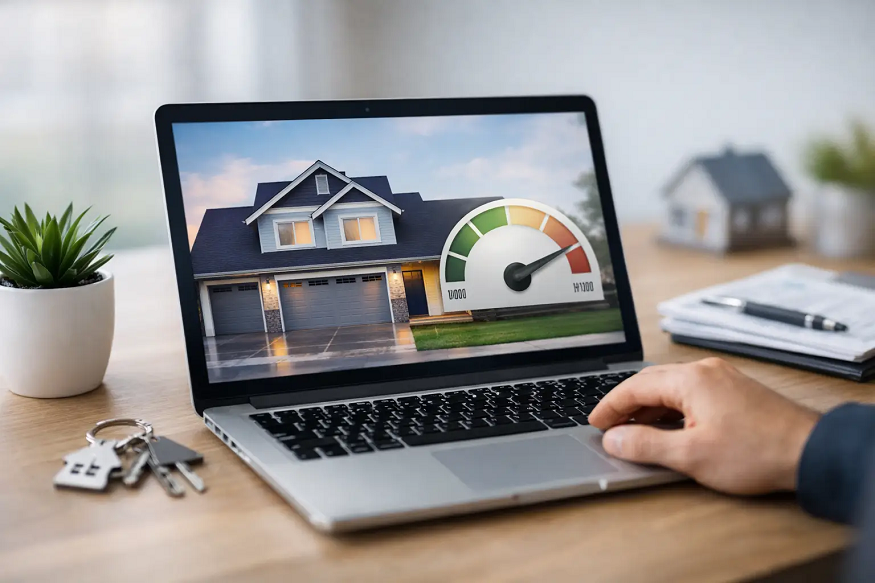
The first question many homeowners ask before selling is simple: how much is my home worth? Until recently, answering it usually meant arranging an estate agent visit, but automated property data now gives sellers an indication within minutes. That speed is useful when you are exploring a move, calculating available equity or deciding whether selling makes financial sense. An instant online house valuation can provide that early benchmark without committing you to putting the property on the market.
An instant online house valuation typically estimates value using property records, previous transactions, local sales evidence and other available data. For sellers, its greatest advantage is convenience, but the number on screen should be treated as a starting point rather than a guaranteed asking price. Individual property features and current buyer demand can create a meaningful difference between an automated estimate and the price achievable on the open market.
Fast Estimates Improve Planning
Sellers do not always want an estate agent appointment when they first start thinking about moving. You might simply be considering whether your existing equity could fund a larger home, a relocation or a change in mortgage. An automated valuation provides an early figure that can help make those conversations more concrete.
Read More: Ithaca, Manhattan, and Bronx: Why These New York Cities Are Perfect for Homebuyers
For example, a homeowner who bought several years ago may have little idea how local prices have moved since their purchase. An online estimate can indicate whether further investigation makes sense before they start arranging viewings or speaking to a mortgage adviser about their next property.
The overlooked risk is building an entire moving budget around one automated figure. Sellers should allow for uncertainty until the estimate has been tested against stronger evidence. A useful professional approach is to compare the result with recent nearby transactions before using it to calculate an onward purchase budget.
Property Differences Affect Accuracy
Automated valuation technology works particularly well when there is useful data for genuinely comparable properties. If several similar homes have recently sold nearby, an instant online house valuation has stronger evidence from which to estimate a figure.
The challenge comes with homes that are harder to compare. Extensions, substantial renovations, unusual layouts, larger gardens, parking, views and differences in condition can influence buyer behaviour. A detached house in a road dominated by semi-detached properties may also have fewer useful comparables than an apartment in a development where similar units regularly change hands.
Sellers sometimes assume every improvement adds its full cost to the property’s value. It rarely works that simply. A new kitchen may improve presentation and saleability without increasing the achievable price by exactly what it cost to install. Experienced agents look at improvements through the eyes of current buyers, not merely through the seller’s renovation budget.
Recent Sales Need Context
Comparable sales are central to property valuation, but even accurate historical data needs interpretation. A nearby home may have completed recently while the price was agreed months earlier. If mortgage rates, available stock or buyer confidence changed during that period, its sale price may not perfectly represent today’s market.
Current competition matters too. Imagine your valuation is supported by several previous sales at similar prices, but three comparable properties have just reached the market. Buyers suddenly have more choice, potentially changing the pricing strategy needed to secure attention.
This is one reason an instant online house valuation should not automatically become the asking price. Sellers need to understand both historic evidence and present competition. The professional tip is to examine how long comparable listings have remained available and whether asking prices have been reduced. Those signals can reveal market conditions that a headline valuation alone cannot explain.
Asking Prices Need Strategy
Market value and asking price are closely connected, but they are not always identical. An asking price is also a marketing decision designed to position a property against competing homes and attract the right pool of buyers.
Setting the price too high can reduce early viewing activity. A listing may then require reductions after several weeks, by which point buyers who noticed it at launch may wonder why it has remained unsold. Pricing too cautiously has risks as well, particularly if demand is limited and the expected competition between buyers never develops.
Strong sellers use valuation evidence to define a realistic range and then choose a launch strategy based on local demand. Staging, photography and presentation can strengthen that strategy, but they cannot indefinitely compensate for an asking price buyers consider unrealistic. Early viewing and offer patterns should therefore be treated as useful market feedback rather than ignored.
Local Expertise Tests Estimates
Does an online estimate replace an estate agent valuation? For sellers preparing to market, usually not. The two approaches provide different information. Automated tools offer speed and data-led consistency, while a knowledgeable local agent can inspect condition, assess individual features and consider current buyer behaviour.
Take your instant online house valuation to the valuation appointment and ask the agent to explain any difference. A higher agent figure is not automatically better, just as a lower estimate is not automatically more accurate. The strongest valuation should be supported by relevant comparable evidence and a convincing explanation of how the property would compete if launched now.
Be particularly cautious about choosing an agent solely because they suggest the highest asking price. Winning an instruction and achieving completion at that figure are different things. Professional experience shows that a realistic pricing strategy, supported by active buyer demand, is generally more useful than an ambitious valuation without evidence.
Conclusion
An instant online house valuation gives sellers something genuinely useful: a fast indication of value before they commit to the selling process. It can help with equity calculations, moving plans and early affordability decisions while providing a benchmark for later conversations with estate agents.
Read More: Home Backup to Outdoor Power: Understanding Solar Generator Systems
Its limitations matter just as much as its convenience. Automated estimates may not fully capture renovations, condition, unusual features or changes in local demand. Historical sales also need to be considered alongside properties competing for buyers today.
Use the estimate to begin your research rather than finish it. Compare recent transactions, examine current listings and think carefully about how your home differs from nearby properties. When you become serious about selling, arrange an in-person valuation and ask for evidence behind the recommended asking price. Combining instant data with informed local judgement can create a stronger route towards a successful sale.
 Ithaca, Manhattan, and Bronx: Why These New York Cities Are Perfect for Homebuyers
  Instant online house valuation helps sellers price smarter
  How I Reclaimed My Week: A Genuine Happy Clean Review (The Go-To Cleaning Company in Dublin)
  Kitchen Upgrades That Make Sense for Homes Along the Wasatch Front
  Gypsum in Cement and Plaster: Why It’s Essential